Showing posts with label Church Membership. Show all posts

Tuesday, April 01, 2014

Daily Links 4-1-14

In today's edition: advice for parents, remembering Opening Day, life lessons from Monopoly, valuing church membership, and more.

************

The hardest thing about becoming a parent is the wealth of often conflicting advice you receive before (and even after) you become a parent. But this is a good summary of things that many parents would agree that they wish they knew before becoming a parent.

************

A collection of Ansel Adams photographs that were discovered in the National Archives.

************

Is college for everyone? In part 2 of their series at Art of Manliness, the guys sort through the pros and cons of attending a four year college. 

************

Yesterday marked Opening Day in Major League Baseball for many teams. Mental Floss has a nice look back at the opening of four iconic ballparks. Below, Wrigley Field (formerly Weeghman Park) in April 1914.


*************

Speaking of baseball, this season marks the adoption of instant replay for disputed calls. As this study shows, the umps should be glad that teams can't use replay to argue ball and strike calls.

*************

This is an interesting post: 12 ways life is like a game of Monopoly. Who knew that a game could be so educational?

*************

With the release of Noah and Son of God it's a good time to weigh good versus bad faith-based films:

Christian parents would not let their high school children see the movie of Crime and Punishment if it were simply described to them or flashed in front of them during the previews before another film. But those same Christians do let (and encourage) their kids to read it as a novel because of the universal recognition of Dostoevsky’s masterful storytelling and the unmistakably Biblical anchor his stories were moored to. People love Dostoevsky – who never shied away from confronting humanity as it is – because what he produced was great art.
I’m not suggesting that people of faith who care about what their kids’ minds are filled with should run willy-nilly into every crowded theater to see whatever is fashionable at the time. Hardly! 
But what I am suggesting is that while we work to inspire and equip new generations of artists who share our values to boldly venture into the pop-culture fray, we must not miss opportunities to introduce our worldview into the cultural conversation.
When Christians are perceived to be hiding from the tough questions and human struggles we’re all faced with, they are dismissed and ignored (along with their message of hope). Art has the power to transcend and speak to the soul. But it must be able to meet people on their level before pointing them upward.
***********

Is church membership required?

This month we will be inducting new members into the most honored body the world has ever known: the church of Jesus Christ. The initiation fee for this club is so high that no human could have ever paid it; God himself had to pick up the tab. The benefits of the club never expire. The fellowship of the club is unmatched; you receive intimate access to the Lord himself (John 17:23). 
With such benefits, you'd think church membership would be held in infinitely high esteem. But for many reasons, Christians seem to think less of it than ever before. If you're one who looks upon church membership lightly, then I invite you to reconsider. 
When we hear the word membership, we immediately think of a club. A member pays dues, comes to meetings, and fulfills the obligations of a club member. When you move, or no longer have time for the club, you simply withdraw your membership and move on.
The Bible says membership is much more intimate. "For no one ever hated his own flesh, but nourishes and cherishes it, just as Christ does the church, because we are members of his body" (Eph. 5:29-30). 
To be a church member means we are a member of Christ's body—just like your finger is a member of your body. His blood runs through us. His Spirit animates us. His will moves us. He feels our pain, cleanses us when we get dirty, nurses our wounds, and cherishes us with pride.
Leaving the church is not simply leaving a club. When you walk away, you dismember yourself from the body. Jesus and the rest of the body sorely miss you, and bleed after your departure. You cut yourself off from your only source of life and nourishment. Like an amputated hand, you will slowly bleed out, wither, and die.

Friday, December 20, 2013

Daily Links 12-20-13

Some interesting links for your weekend reading: America and the culture of vulgarity, combating legalism, why men don't listen, and more.

******************

Interesting thoughts on the coarsening of American culture from Dr. Albert Mohler:

The collapse of the barrier between popular culture and decadence has released a toxic mudslide of vulgarity into the nation’s family rooms—and just about everywhere else. There is almost no remote corner of this culture that is not marked by the toleration of vulgarity, or the outright celebration of depravity. 
Lee Siegel has seen this reality, and he doesn’t like it. “When did the culture become so coarse?,” he asks, adding: “It’s a question that quickly gets you branded as either an unsophisticated rube or some angry culture warrior.” 
Siegel wants us all to know that he is neither unsophisticated nor a culture warrior. In his recent feature essay in The Wall Street Journal, “America the Vulgar,” Siegel recites his cultural bona fides. As he relates, “I miss a time when there were powerful imprecations instead of mere obscenity—or at least when sexual innuendo, because it was innuendo, served as a delicious release of tension between our private and public lives.” 

*****************

Dealing with the problem of legalism:

The “L” word. It’s one of the ugliest of all words: legalism. Defined as the idea that we can earn right standing with God, it does violence to the glorious gospel of Christ. It says, “No, sorry, it’s not enough,” to the substitutionary atoning work of Christ. It confuses the way to forgiveness, it tarnishes the gospel of grace, it lays up heavy burdens that no one can carry, it crushes hope, and fuels despair. It declares that man possesses finesse to propitiate the just wrath of God due our sin. For that, legalism is deadly and must be opposed at every level. Paul called it another gospel whose proponents are condemned (Gal 1:8-9).
Consequently, labeling something/one legalistic ought to be done with caution. To bring the charge is to say that this thing or person is in danger of propagating an unsavable system and trampling the cross of Christ. So if we label something legalistic, we better thoroughly understand the gospel, the definition of legalism, and what exactly is happening with what we are labeling as legalistic. Otherwise, we are sinning by erroneously labeling something in opposition to the cross of Jesus Christ.

****************

Kevin DeYoung has some tough questions for those he refers to as the semi-churched:

This is one of those posts I've wanted to write for awhile, but I wasn't sure how to say what I think needs to be said. The danger of legalism and false guilt is very real. But so is the danger of disobedience and self-deception.
I want to talk about church members who attend their home church with great irregularity. These aren't unchurched folks, or de-churched, or under-churched. They are semi-churched. They show up some of the time, but not every week. They are on again/off again, in and out, here on Sunday and gone for two. That's the scandal of the semi-churched. In fact,Thom Rainer argues that the number one reason for the decline in church attendance is that church members don't go to church as often as they used to. 
We've had Christmas and Easter Christians for probably as long as we've had Christmas and Easter. Some people will always be intermittent with their church attendance. I'm not talking about nominal Christians who wander into church once or twice a year. I'm talking about people who went through the trouble of joining a church, like their church, have no particular beef with the church, and still only darken its doors once or twice a month. If there are churches with membership rolls much larger than their average Sunday attendance, they have either under-shepherds derelict in their duties, members faithless in theirs, or both.
I know we are the church and don't go to church (blah, blah, blah), but being persnickety about our language doesn't change the exhortation of Hebrews 10:25. We should not neglect to meet together, as some are in the habit of doing. Gathering every Lord's Day with our church family is one of the pillars of mature Christianity. 

******************

Matt Walsh has some observations on why guys don't listen and what we can do about it.

*****************

House plans from classic novels:


More novels featured at the link.

*************

A collection of vintage ads for libraries and reading:


Wednesday, November 27, 2013

Daily Links 11-27-13

Things to do before leaving your church, John Piper on Calvinism, benefits of being a boring guy, managing information overload, and more in today's links.

*****************

Thabiti Anyabwile has a useful article on things to consider before leaving your church. Fact is that most people will at some point leave their church. These are some good things to consider prior to departing.

*****************

James Clear on how we consume information:

How much time do you spend consuming information that you have no intention of taking action on or that you don’t care deeply about? 
For example: the nightly news cycle of local crimes, the endless stream of Facebook and Twitter updates, celebrity gossip, reality TV shows, Buzzfeed articles. The list goes on. 
In this age of information overload, your life can be filled with irrelevant or unnecessary information in an instant.
And here’s the main problem: 
After a while, these information sources start to become normal. Pretty soon, you’re logging onto Facebook because of the fear of missing out on “something.” You turn on the news or check CNN, not because you care about a particular topic, but merely out of habit. You watch tonight’s reality TV show because that’s what you always do on Thursdays at 8pm. 
Now don’t get me wrong, I’m all for learning and soaking up new information. After all, education is one of the master keys to the universe. And staying up-to-date on important stories can help shape your worldview and make you a good global citizen. 
But it is becoming dangerously easy to consume low quality information and convince yourself that it’s normal and good, when it isn’t helping you live a better life at all.

***************

Redefining the meaning of being boring. I strive to be boring every day.

***************

Tim Challies reviews John Piper's new book Five Points: Toward a Deeper Experience of God's Grace. It looks like it's a good read.

***************

In what order should you read the Chronicles of Narnia by C. S. Lewis? Some would argue for chronological order. However, the more sensible plan is to read them in publication order. That's the way we read them as a family and it's the order that makes the most sense.

***************

Answering the big questions: why you wake up before the alarm goes off.

Friday, October 18, 2013

Daily Links 10-18-13

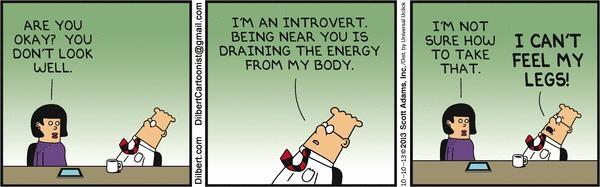
Introverts, tinkering, stay-at-home moms, traits of wildly successful people,

****************

This is hilarious (and true)::

Hat tip: Stephen Mansfield

****************

When you don't know where to start, just tinker.

[A] funny thing often happens when you “just” start setting up and tinkering: you forget about the big, intimidating picture, and start taking small actions that will actually more the project forward. You begin by tweaking and tinkering, and before long, your imagination sparks into life and you’re happily absorbed in the work. You’ve started in earnest without even noticing it.

*****************

It's time to stop denigrating mothers who stay at home to raise their children:

The people who completely immerse themselves in the tiring, thankless, profoundly important job of raising children ought to be put on a pedestal. We ought to revere them and admire them like we admire rocket scientists and war heroes. These women are doing something beautiful and complicated and challenging and terrifying and painful and joyous and essential. Whatever they are doing, they ARE doing something, and our civilization DEPENDS on them doing it well. Who else can say such a thing? What other job carries with it such consequences?

It’s true — being a mom isn’t a “job.” A job is something you do for part of the day and then stop doing. You get a paycheck. You have unions and benefits and break rooms. I’ve had many jobs; it’s nothing spectacular or mystical. I don’t quite understand why we’ve elevated “the workforce” to this hallowed status. Where do we get our idea of it? The Communist Manifesto? Having a job is necessary for some — it is for me — but it isn’t liberating or empowering. Whatever your job is — you are expendable. You are a number. You are a calculation. You are a servant. You can be replaced, and you will be replaced eventually. Am I being harsh? No, I’m being someone who has a job. I’m being real.

If your mother quit her role as mother, entire lives would be turned upside down; society would suffer greatly. The ripples of that tragedy would be felt for generations. If she quit her job as a computer analyst, she’d be replaced in four days and nobody would care. Same goes for you and me. We have freedom and power in the home, not the office. But we are zombies, so we can not see that.

*****************

Five traits of wildly successful people:

I have a crazy idea: success isn’t just about hard work. We hear about hard work all the time—it’s what Olympic champions talk about when they get to the top of the podium and it’s what the media credits as the sole force behind entrepreneurs. But there has to be something else in the equation of obtaining unimaginable success. What other traits tipped the odds in favor of the world’s most successful people?

The actual traits will surprise you.

*****************

25 reasons regular church attendance is important.

*****************

Mike Rowe has been preaching the value of hard work. Now he's funding a new scholarship program to help students develop skills for jobs currently available in the United States:

Mike Rowe, formerly of Dirty Jobs, appeared on TheBlaze TV’s “Wilkow!” Thursday night to discuss his exciting new scholarship program, the mikeroweWORKS Scholarship Fund. The goal is to get high school seniors ready to enter the workforce with the skills they need to land the jobs that are available in the U.S. — the key word being available.

“The jobs right now that we have available, people don’t seem to want — and it makes no sense because we’re lending money we don’t have to kids who can’t pay it back to train them for jobs that no longer exist,” Rowe told TheBlaze TV’s Andrew Wilkow.

Each mikeroweWORKS scholarship is worth $15,000 on average — a nice chunk of change. However, any high school senior interested in the program must first take the “S.W.E.A.T. Pledge” (Skills and Work Ethic Aren’t Taboo) and make a case as to why they are deserving of the scholarship in the form of a video.
“If your not willing to sign it, this particular pile of free money is probably not for you,” Rowe said.
*****************

A fun list of 11 book sequels you probably didn't even know existed.

Monday, August 12, 2013

Worship Thoughts: Greeting Time

So far in this series of posts, I've been sharing some thoughts about worship and some of the things that are being done routinely in church that perhaps would be better left out. Today, I want to address another of the "sacred cows" of the church: the greeting time.

In almost every church I have visited, there is some period of time set aside during the service to "greet one another". Presumably this is an opportunity for church members to greet visitors and get to know them better. What seems to happen more often than not is that folks spend lots of time shaking heads but never really getting to know one another. Part of that is the constraints of time. It's hard in the course of a couple of minutes to start a meaningful conversation with someone especially when that person already feels a little uncomfortable and out of place. Of course, as an introvert I'm not inclined to engage in meaningless conversation. I'm naturally uncomfortable in large gatherings. Greeting time usually ends up being the most excruciating part of the service. 

By the way, is it too much to ask for folks to introduce themselves? I can't tell you how many times I have visited a church where no one wants to tell me their name. 

The other issue is the fact that the greeting time ends up disrupting the flow of the worship service. I've experienced this both as part of the congregation and as a worship leader. It's difficult to get folks focused back on worship after they have been up shaking hands and chatting with each other.

I'm all for trying to make visitors feel more comfortable in the church. As a matter of fact, I think most churches don't expend enough energy welcoming visitors to the church. But it also seems that the best time to do this is either before or after the worship service. But interrupting the service for a few minutes of chit-chat seems to be counterproductive. Like so many of the other elements of worship that have become entrenched in our services it would be wise to reconsider whether greeting time is really accomplishing what needs to be accomplished. If it isn't then maybe it's time to stop doing it. 

Previous entries in this series:


Monday, August 05, 2013

Worship Thoughts: The Visitor's Card

In almost every church I have ever visited there is always the issue of the visitor's card. Churches routinely use such cards to gather information on guests to the church. How such information is used varies from church to church but the purpose is generally the same: find out as much information as they can about newcomers to the church.

Recent experiences with the visitor's card have put me off filling out one ever again. Not long ago I was in a church where I had filled out a card. The next morning the pastor showed up unannounced at my front door wanting to talk about the church. Sadly, I had already determined based on our visit that the church was not a fit for our family. So from now on, I am adopting the following attitude towards the visitor's card:

Please don't force me to fill out a visitor's card. Don't make me write down any information, especially if I have already sidestepped your first appeal to get me to do so. I don't want to hurt your feelings, so don't make me have to keep coming up with excuses. The truth is that I’m not going to fill out anything until I am sure that your church might be a real option for me.
That's the rub. It's hard for a person coming to a church for the first time to decide whether that's the place for them based on one hour of worship. It would be like deciding to marry someone after only a single date with them. It's not advisable. You haven't had an opportunity to get to know them yet.
The same holds true for church. Church needs to be a place where you can be involved, where you can fellowship with other believers and be an integral part of the body of Christ. Membership in a church is a serious commitment and one that should not be entered into lightly. So it would be better for churches to keep that in mind and not pressure newcomers into rushing into a relationship they may not be comfortable with.

Previously in this series - Worship Thoughts: Special Music