Showing posts with label Space. Show all posts

Friday, March 02, 2018

Weekend Links 3-2-18

After an unexpected week off a whole host of links for your weekend reading. I'm spending the weekend off of social media and am going book hunting. We'll see how that goes. Meanwhile, enjoy these articles.

This is fascinating: these astronauts have seen Earth from space. Here's how that experience changed them.

Odd but true: divers found an undetonated World War II bomb in Sydney harbor.

Someone decided to abandon a Boeing 737 in Bali and nobody knows why.

If you can't remember the last book you read or the last movie or television show you saw you're not alone.

Speaking of reading, here's how to read more books. I have found that I have to make time every day to read. Plus I have at least one book I am working on at any given time. Right now I am churning through about seven books a month and that feels like a pretty good pace. I also follow lots of different bookish people on Instagram and it's a treasure trove of inspiration.

Tim Challies weighs in on why men don't read books written by women. I think he's on the right track in terms of how writers target their writing for a particular audience but mostly I think it has to do with how publishers market the books.

Quote of the week: Carl Trueman on the Oscars:

I make a point of never watching the Oscars. If I want to waste four hours of my life being alternately patronized and reminded what an abject failure I am according to the criteria of contemporary society holds dear, I can always read The New Yorker.

I don't like to wade into politics here any more in large part because it has become far too toxic to discuss. However, I couldn't pass up the opportunity to share this column from Mona Charen. Last week she was booed off the stage at CPAC because she dared to call conservatives on their hypocrisy when it comes to sexual harassment and the chronic excusing of past behaviors of their candidates. I applaud her for her courage. I wish more conservatives had her backbone.

Guns have also been a hot topic in the aftermath of the shooting at Stoneman Douglas High School in Florida. But this piece by David French is very thoughtful and worth careful consideration.

Joe Carter wraps up his series on how Christians should engage with the news. In summary, consume less of it. The previous installments are here, here, and here.

A related issue that frankly has been woefully under-reported is the plague of fatherless homes. Matt Walsh has some great insights into things every boy needs to learn from his father.

Matt Szczur may have moved on from the Cubs to the Padres but he still has fond memories of the 2016 World Series. He's also quite the talented artist.

"Great people choose to do what is right no matter what." That certainly rings true for Iowa's Jordan Bohannon who missed a free throw on purpose.  A very classy move.

Friday, February 09, 2018

Weekend Links 2-9-18

It's a cornucopia of interesting links this week.

This is interesting: 16 facts about Ray Bradbury's Fahrenheit 451. This makes me want to go read the book.

Articles like this make it harder to enjoy football. There was a time when I was truly interesting in watching it. Not anymore.

If you are a football fan enjoy it while you can because the sport is doomed.

Thomas Boswell was right - baseball is better than football. There's also this from George Carlin.

Spring training starts next week. Here are the report dates for every team.

One of the best shows currently on television is the Inspector Morse prequel Endeavour (shown on PBS here in the United States). This is a fascinating interview with Russell Lewis, the series creator and sole writer.

America is at her greatest when she accomplishes great things. Just ask Elon Musk. (As a side note, I am currently reading a second book on the Apollo space program and find myself longing for the days when we dared to do difficult things).

This seems to fall more in the category of "don't try this at home". However, I know of at least one person who does one of the things on this list regularly.

How Groundhog Day (released 25 years ago!) shows we are "stuck with virtue".

Quote of the week:

Abide is an old fashioned word. It simply means remain, stay, or dwell.  The challenge is for us to continue to be immersed in, satisfied by, surrounded by, empowered by, protected by, and infused with Jesus.
Read the whole thing.

Some interesting thoughts on The Post and the current state of the press. Lots of stuff here to think about.

This is an amazing article written by a long-time photojournalist. The story - about one man and a photograph - is pretty remarkable.

This article from WORLD Magazine on the current turmoil at Moody Bible Institute is incredibly detailed and provides a pretty comprehensive account of the challenges facing the college.

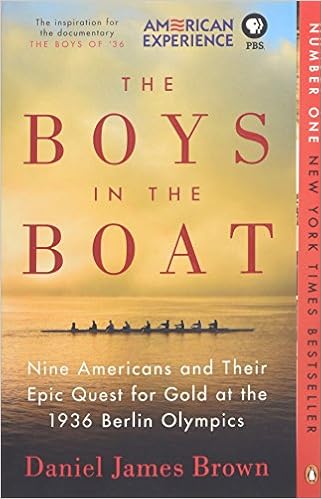
Recommended reading: The Boys in the Boat by Daniel James Brown.
This book wasn't on my to be read list at the beginning of the year but I ran across it a library book sale and couldn't resist. I had seen it recommended several places and now I understand why it was getting such tremendous endorsements. It's an amazing account of a group of working-class boys who fought theri way through the Great Depression to defeat the heavily favored German team in the 1936 Berlin Olympics. It's a terrific read and well worth your time.

Incidentally, pay particular attention to the prologue of the book. I love the story of how the author stumbled onto this tale. It made reading the book even more enjoyable.

Friday, January 10, 2014

Daily Links 1-10-14

Here's a huge roundup of links to get your weekend started off right: some unusual things that have traveled into space, some neat history, perfect spaghetti marinara, and more.

*****************

Over at Mental Floss, a list of 9 unusual things that astronauts brought into space. My personal favorite is the Silver Snoopy Lapel Pin.

*****************

An interview with Glenn Harlan Reynolds over at National Review about the state of higher education and, of course, his new book.

*****************

I always thought the first submarines appeared during the Civil War. Turns out I was wrong. The first submarine was actually invented during the Revolutionary War.

*****************

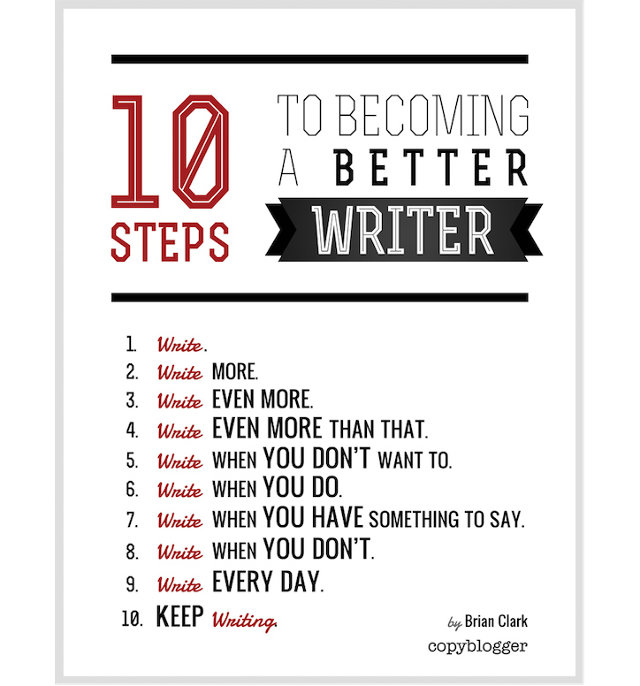
Tips for becoming a successful writer.


****************

Kevin DeYoung shares the Ten Commandments of Twitter. Some great advice in this post.

****************

Chef Scott Conant shares his secrets for making the perfect spaghetti marinara. I've had this dish at Scarpetta Las Vegas (incidentally, one of the best meals I have ever had at a restaurant) and it is fantastic. If you start making spaghetti this way you will never want to prepare it any other way. Trust me on this.

****************

Is it possible to be a comedian without swearing or talking about sex? Jerry Seinfeld proves that it can be done. (Hat tip: Acculturated)

****************

A collection of nine sentences guaranteed to make a grammar nerd's head explode. English is tough.

Saturday, January 29, 2011

Remembering the Challenger: 25 Years Later

Yesterday marked the twenty-fifth anniversary of the Space Shuttle Challenger explosion. For those who remember the day we were shocked by the disaster. Americans had erroneously believed that spaceflight had become almost routine. Challenger would remind us just how dangerous the business of space flight really was. It's surprising then, in retrospect, to realize that CNN still covered the launch live.


It's a national tragedy such as this that brings out the best and worst in a nation's leaders. President Ronald Reagan rose to the occasion. He was supposed to give the annual State of the Union address that evening. However, in light of the tragedy it seemed far more appropriate to pay tribute to the fallen seven astronauts.


It would be the first time America lost a crew in space. Unfortunately, it would not be the last. But they understood the risks they were taking and for that they are properly remembered as heroes.

President Reagan appropriately borrowed his closing line from the poem High Flight which is a mantra for pilots: "And slipped the surly bonds of earth to touch the face of God."

Wednesday, July 01, 2009

Book Review: Failure Is Not An Option: Mission Control From Mercury To Apollo 13 And Beyond by Gene Kranz

I was only 3 years old when Apollo 11 landed on the moon. But I remember the landing like it was yesterday. My parents made sure to get me out of bed to watch Neil Armstrong and Buzz Aldrin walk on the moon as they understood what an amazing piece of history we were witnessing.

Since that time I have been enamored with space travel. In fact, like many boys my age I dreamed of becoming an astronaut until I grew too tall to qualify (I am 6'6" and the maximum height allowed for an astronaut was 5'11").

I have numerous accounts of the space program but up until now had not read a flight director's account of the space program. That is, not until I just finished Failure Is Not An Option: Mission Control From Mercury To Apollo 13 And Beyond by Gene Kranz. To find out more about the book, check out my review here.

Friday, June 06, 2008

TV Preview: When We Left Earth: The NASA Missions

In the past hundred years, the single greatest achievement of mankind is without a doubt our conquest of space. In less than 10 years, the American space program would go from knowing next to nothing about putting a man in space to landing atwo men on the moon and returning them to Earth.

Discovery Channel chronicles the first 50 years of NASA's successes and failures in a brand new documnetary entitled When We Left Earth: The NASA Missions which premieres on June 8 at 9PM EDT/PDT. The series is narrated by award-winning actor Gary Sinise. Over three consecutive Sunday nights, this series will take the viewer on a journey through the history of the space program like no other documentary ever has before.

"This project started out as a preservation endeavor," said executive producer Bill Howard in a recent interview. "We sat down with NASA and explained to them that we wanted to go back through their archives and preserve and remaster all of their original film source material, the film that had been to the moon and had been in space, the real treasures of the NASA archives."


Click here to listen to an interview with executive producer Bill Howard.


What followed was a painstaking process in which the producers viewed more than 500 hours of footage and converting over 100 hours into HD to be used in this series. HD copies were then donated back to NASA.

But they didn't stop there. The producers also went through the process of digitizing the audio archives which also proved to be a monumental task.

"At the time of Mercury and Gemini, they didn't record the audio on the same medium as the picture," explained Mr. Howard. "Film would be shot in space and the audio would be recorded back in Houston on some custom government magnetic reel to reel tape and you go back and you try to access those magnetic tape sources. Some of them are completely degraded and can't be played. Others are fragile and have to be handled with such care that you only get one chance to digitize it."

The result of all this work is a visually stunning series that puts the viewer right in the middle of what the astronauts experienced on these missions. You feel as if you're in the spacecraft alongside these astronauts as they embark on these magnificent adventures. For the first time, mission footage has been synchronized with the audio so that viewers will get to not only see but hear the astronauts during these missions.


Interspersed with the archival footage are present day interviews with both the astronauts and some of the flight directors. Viewers will get a greater understanding of the character of the men and women who undertake the challenge to explore space.


The first episode, entitled "Ordinary Supermen", begins with the earliest days of NASA. The Soviets have already launched Sputnik to begin the Space Race. NASA is working feverishly to try to catch up. They recruit the best pilots they can find to become the first astronauts. Out of 110 who qualify, only seven will become Mercury astronauts. Interviews with the two surviving Mercury astronauts, John Glenn and Scott Carpenter, are included to provide insight and personal recollections from their missions. In order to make it into space, NASA has to invent completely new technology. As flight director Gene Kranz puts it, learning to fly into space was like "learning to drink from a fire hose".


Episode two, "Gemini-Friends and Rivals", provides rare footage of the recruiting and training process and focuses on the steps that must be achieved to make it to the moon. Ed White's inaugural space walk on Gemini 4 is stunning to watch in HD. Another highlight is Gene Cernan's space walk on a later Gemini mission. For the first time, we get to hear Cernan's struggle to work in space with the mission audio synchronized to the film. Cernan also provides present-day recollections that add to the drama.


The third episode, "Apollo-Landing the Eagle", opens with the first major tragedy of the space program: the Apollo 1 launchpad fire that killed astronauts Gus Grissom, Ed White, and Roger Chaffee. NASA bounces back to a few months later launching Apollo 8 which was the first mission to achieve lunar orbit. The footage from this mission (including shots of the stages of the Saturn V rocket separating) is absolutely incredible. The episode concludes with the Apollo 11 landing and NASA's greatest achievement to date.


Episode 4, "A Home in Space", begins with Apollo missions 12-17 and the near-disaster of Apollo 13. Astronauts Jim Lovell and Fred Haise and flight director Gene Kranz put us right in the middle of the drama with their recollections of the ill-fated mission. As the Apollo program winds down, NASA decides to take the leftover hardware to create Skylab, the first attempt to put a space station into orbit.


Episode 5, "The Shuttle", brings us to the next great chapter of NASA's history. Astronauts John Young and Robert Crippen share their memories of the first shuttle launch which holds the distinction of being the first time that NASA will test a new vehicle with astronauts aboard. Both Young and Crippen tell us what it's like to ride a thoroughly untested spaceship. Another highlight is the footage from astronaut Bruce McCandless' untethered spacewalk which was the first time it was ever attempted. The episode concludes with the Challenger explosion and includes some specially declassified material of the solid rocket boosters being destroyed following the explosion of the Challenger.


As episode 6, "A New Space Age", opens, NASA is reeling from the Challenger disaster and scrambles to get the shuttle flying again. Their next great endeavor is the Hubble Space Telescope. But after deployment, they discover huge problems with it that require a daring repair mission that is documented here. After the successful repair of Hubble comes the Columbia disaster which, as the mission footage shows, might have been avoided. The onboard footage of the crew as they begin re-entry is eerie to watch. As with the other missions, the film is remarkable to watch. The series concludes with the construction of the International Space Station and the next great chapter of space exploration.


Unlike other documentaries about space, this series focuses more on the men and women of NASA than the technical achievements.


"What we tried to do is look at it as an adventure story: real heroes, real stakes, and relal jeopardy," said Mr. Howard. We gave it a theatrical score and built it as we would build an adventure movie and I think that's our effort any way to make it relevant to people now by putting it in a medium they understand: high definition television with a full theatrical score."


When We Left Earth: The NASA Missions certainly accomplishes that objective. It is our greatest adventure.


When We Left Earth: The NASA Missions will air on the Discovery Channel at 9PM EDT/PDT on June 8, 15 and 22.


This article was originally published at Blogcritics.